 |
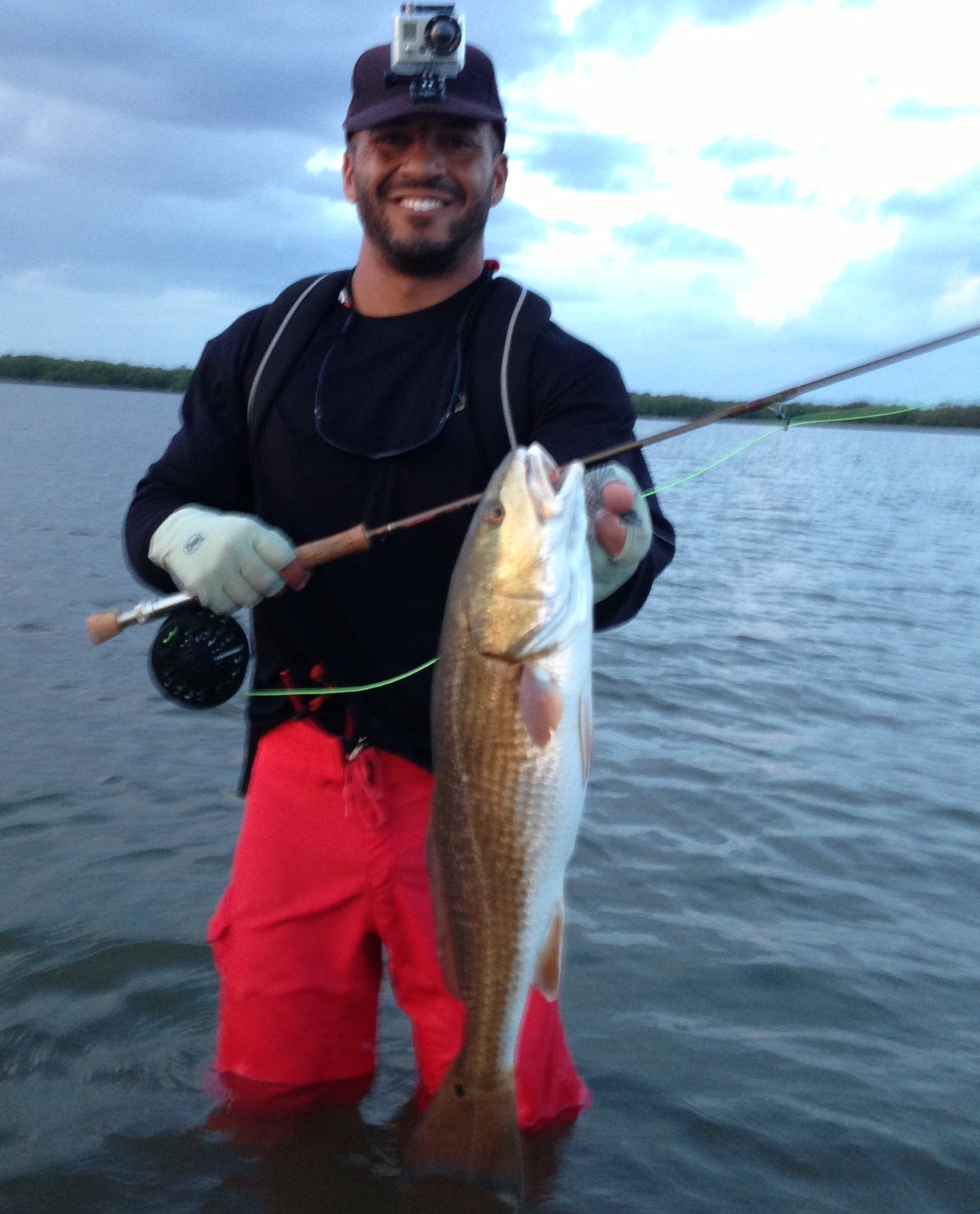
| A nice Tampa Bay red on fly. |
Tuesday, July 9, 2013
Summer Reds in the Bay

Monday, July 8, 2013
Fly fishing Dispute Heads to Court
Former Washington Redskins running back John Riggins is suing the host of Fly Rod Chronicles for using footage of Riggins not approved by the former NFL star.
Sadly, fly fishing, like everything else, has become a business.
The lawsuit
Sadly, fly fishing, like everything else, has become a business.
The lawsuit
Friday, July 5, 2013
Bendbacks
One of my first efforts at tying the Bendback.
The hope is that it's truly weedless in the Tampa Bay turtlegrass as I
pursue tailing redfish. The key is to tie sparse and not to bend the hook too much.
With reds and turtle grass, it's tough not to get hung up when trying to sight fish on the lower tides. Don't fish deep enough, then maybe the fish doesn't see the fly. Fish too deep and you get hung up. Will the Bendback solve this? We'll see.

With reds and turtle grass, it's tough not to get hung up when trying to sight fish on the lower tides. Don't fish deep enough, then maybe the fish doesn't see the fly. Fish too deep and you get hung up. Will the Bendback solve this? We'll see.

Thursday, July 4, 2013
Model Planes
Wednesday, July 3, 2013
The Weather

Tuesday, July 2, 2013
Staying on a Straight Line
I know I've written about Lefty and his casting style before. But this was too good to pass up. I went to a casting clinic in April (see previous post). The instructor was Dayle Mazzarella, who had set up casting lanes with rope along the ground. We were supposed to use the straight line of the rope/lane as a guideline to follow with the rod tip. The point was to maintain a perfectly straight line with the tip during your casting stroke. This is s a huge deal. The straighter the rod path, the more efficient your loops are. Efficiency leads to ease.
This is easier said than done. The problem is, as I've discovered, is that most people have no tip awareness. Why? Because the rod tip is usually above them, out of sight and out mind. Most of the focus is on the butt of the rod. Nothing wrong with that.
But the key is to focus on the tip to get that straight path. The way to do this is take anything in your yard that forms a straight line, edge of a driveway, hedges, strip of grass, etc. Cast a bit sidearm or three quarters and follow the tip as it goes along whatever edge you've chosen. If you have trouble following the edge, that probably means your stroke is too long. What that happens, the tip usually dips and follows a curve. The line will then curve and that's when your loops start to widen.
Once you master this, find two objects that form a gap. Then cast between that gap. I've got a row of bushes and a Magnolia tree. The goal is to keep the fly line in that gap. To do that, you have to maintain a straight line with the rod tip. If your stroke is too long, you'll throw a curve in the line and not be able to stay in the lane/gap. That's what I did for a LONG time before I did this drill. Then I shortened my stroke and the loops narrowed. Big difference in my casting stroke, particularly in the wind. I'm a lot shorter, quicker and more efficient. Worked for me. I think it will for you, too.
Back to the Lefty vid. Lefty doesn't use the tip to measure the rod path. He uses the butt to explain the elbow on the shelf. Different approach. Same goal. The key is to find ways to practice a straight path. Both can work wonders.
Monday, July 1, 2013
A World Record?
A beast of a tarpon was reportedly caught off Anna Maria Island recently. It might have been a world record and likely was a state record.
Del Milligan of The Ledger fills us in on the details behind the big fish.
Del Milligan of The Ledger fills us in on the details behind the big fish.
The monster tarpon was likely
a state record of at least 250 pounds, and possibly a world record. But
four fishermen took turns fighting it, which negates a record, and
Moore didn't have a tarpon tag to keep it.
"I
wouldn't have killed the fish anyway. It's just not worth it to me,''
said Moore, from Holmes Beach and one of the most expert and experienced
charter captains on the Gulf Coast.
Subscribe to:
Posts (Atom)